I'm a paragraph. Click here to add your own text and edit me. It's easy.
I'm a paragraph. Click here to add your own text and edit me. It's easy.
I'm a paragraph. Click here to add your own text and edit me. It's easy.
Latest:


The copyright of all photographs belongs to individual interviewees. Please get in touch for more information
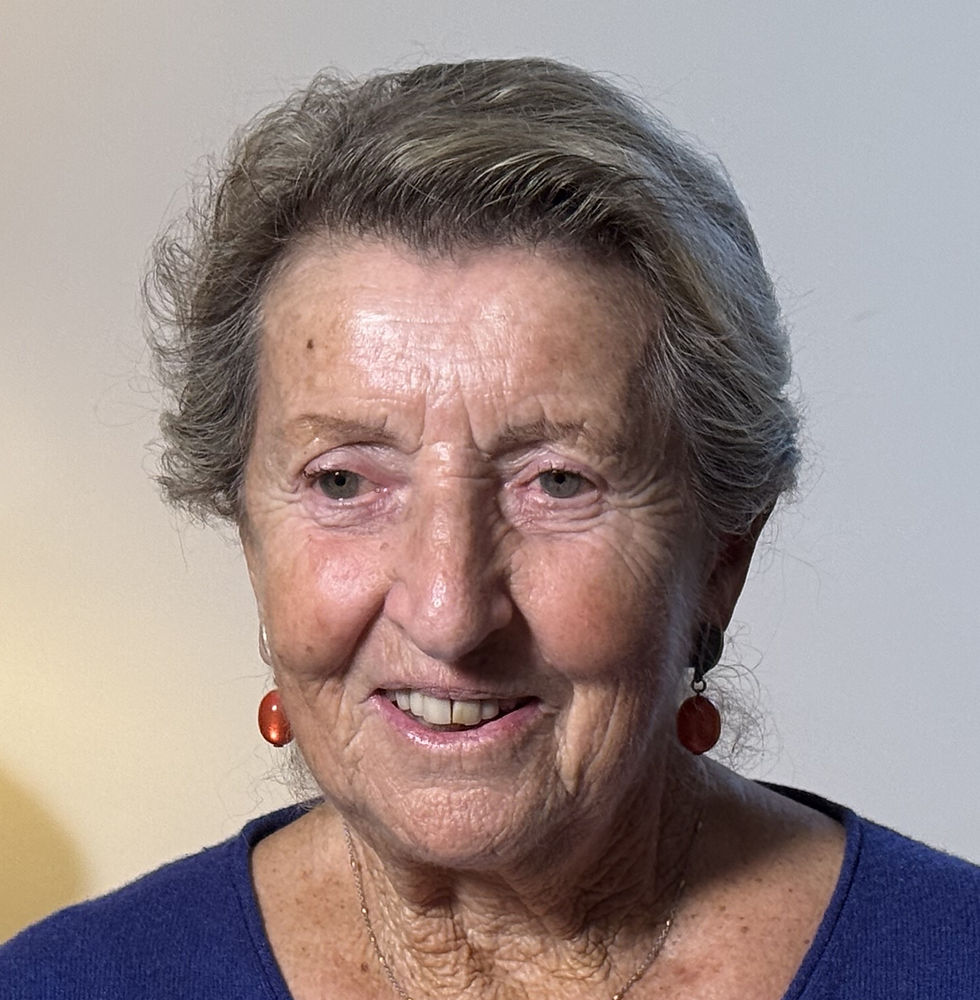
Denise Shenton
Arrived in Britain:
Place of Birth:
Born:
1957
1937
Interview number:
Experiences:
RV
322
Interviewer:
Dr Bea Lewkowicz
Date of Interview:
Tuesday, 28 October 2025
Interview Summary:
Denise Shenton, née Denise Paluch, was born in October 1937 in Brussels, Belgium. Her parents ran a leather goods in the Brussels suburb of Etterbeek, where suitcases and other leather items were sold. Her mother, Licia Jankowiak, came from Kassel, Germany, and was the eldest of four sisters who had all been trained in handbag making. During the Second World War, Denise and her parents were caught up in anti-Jewish persecution. At some point afterwards, Denise and her mother were detained with many other people. Denise remembered large numbers of people gathered together, shouting, poor sanitation, and sleeping on straw.
A Red Cross message written by her mother to her sister in South Africa described their situation briefly, stating that they had been forced to leave everything behind and were in a bad place. Denise believed this message was written while they were being held in difficult conditions during the deportations and later found out that they had been in the internment camp of Vénissieux near Lyon, where thousands of Jews were held under French authority before deportation.
In September 1942, a rescue effort organized by members of the French Resistance saved a group of children from deportation. Abbé Alexandre Glasberg, a Jewish convert to Catholicism who was involved in rescue activities, together with others, approached parents in the camp and asked them to allow their children to be taken away for safety. Denise’s mother agreed to let her daughter go. Denise was among a group of children removed from the camp shortly before a transport of detainees was deported to Auschwitz. Denise never saw her mother again after that moment.
After leaving the camp, Denise was taken to the home of a woman known as Madame Marty in Sainte-Foy-lès-Lyon, near Lyon. Madame Marty ran a residence and school for about forty-five disabled children and had also adopted several children herself. Denise joined this household and lived there during the war under the name Gertrude Marty, called Trudy. Madame Marty was connected to resistance networks and sheltered Jewish children and families passing through her home.
Denise remembered being hidden at times when German soldiers searched the area. She was placed in cupboards, on top of wardrobes, and in other concealed spaces to avoid detection. When German patrols were expected, she was sometimes taken to the adjacent home for disabled children so that she would blend in with the group. Denise also recalled German soldiers frequently being present in the area and occupying the garden of the property.
Denise remembered meals consisting mainly of pasta or rice supplied by the authorities, occasionally supplemented by food from the garden or milk from animals kept on the property. Despite shortages and the constant need for secrecy, Denise described playing with the other children and participating in daily life in the household.
Madame Marty did not baptise Denise or allow her to participate fully in Catholic rites, although Denise attended chapel with the other children. Denise remained with Madame Marty throughout the remainder of the war and for some time afterward. During this period, she began attending school and remained part of the household for several years after the war.
Madame Marty later attempted to adopt Denise, but this was not possible because Denise had surviving relatives. Denise eventually left the household to join her aunt and family in South Africa in December 1947. She never felt at home there and always planned to go back to Madame Marty – “Maman” - in France. She did so eventually in 1957, lived and worked in Paris for a while until she joined a friend in London to learn hairdressing. At a party she met Ernest who was a Jewish refugee from Vienna. They got married in 1960 at Bayswater Synagogue and had four children.
Keywords: Paluch. Jankowiak. Kassel, Germany. Poland. Etterbeek, Brussels. Vélodrome d’hiver. Vénissieux. Madame Marty in Sainte-Foy-lès-Lyon. Abbé Glasberg. South Africa